Education Agents As Drivers of Int’l Student Recruitment

International student recruitment is mostly driven by education agents, who assist international students in selecting a high-quality and top educational institution to enroll in. They are the main point of contact for prospective students who wish to learn more about the universities and program options available to them in the future.
However, through the years, many people have constructed such a broad picture of educational companies cooperating with institutions to recruit international students that is entirely misleading.
Key Takeaways:
- Australian international education sector sought help from education agents
- Australia’s higher education industry heading to full recovery
- More and more offers have been provided by the government to attract students
Because of this, they unknowingly distort the efforts of individuals and organizations who work tirelessly every day to provide high-quality educational opportunities to international students studying in different study destinations.
This is the reality that education institutions and agents have to go through nowadays and various studies and opinion pieces have been created in response to amplify that education agents are the true drivers of the international education sector and not the other way around.
The American International Recruitment Council (AIRC) and the National Association for College Admission Counseling (NACAC) partnered on a quick survey to find out more about how schools are collaborating in international student recruitment.
During the COVID-19 pandemic, there were several different agents used. With a total of 294 valid responses, almost half of survey respondents (49%) said they now work with agents to attract international undergraduate students, and 5% said they are actively looking into agency collaborations as a result of the pandemic.
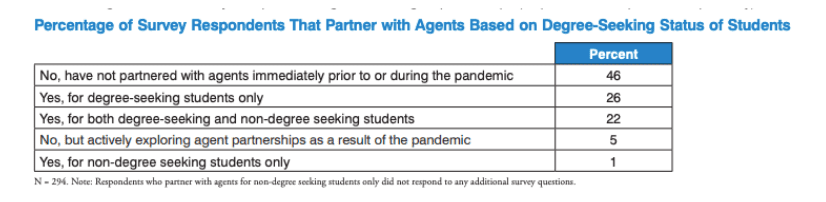
According to the World Bank’s Global Education Director Jaime Saavedra, there is no need to keep schools closed in the face of the pandemic, and even if additional waves emerge, closing schools should be the last choice. Despite the downsides of the pandemic, agent partnerships were more common at private colleges than at public colleges (60% vs. 42%, respectively).
Such manifestations bring us to how education agents truly contribute not only to international higher education but also to the students and their families.
Quality partnerships
Institutions opt to work with education agents to create a presence in specific regions, particularly in areas where it may be hard to recruit directly and achieve expanding enrollment targets.
Quality partnerships between businesses and agencies are more than transactional. These parties must develop a working relationship based on contractual agreements so that each party understands their respective duties. They necessitate time spent getting to know one another and establishing trust.

Since the start of the pandemic, the number of agent partners has changed for a significant majority of universities, with 34% growing and 9% decreasing.
The great majority of survey respondents said the pandemic had no effect on their agent compensation. Compensation grew by 6%, while compensation declined by 2%.

The interaction with education agents has had a major impact on the global education sector. International student services, which assist a larger and more diversified set of students from all over the world, assure institutional and student protection. The role of education agents in engaging universities to accommodate anticipated increases in overseas enrolment has been impacted by agent accreditation.
Comments
Post a Comment